From roads to runways: How Asphalt Grid Systems is redefining pavement durability
A major runway upgrade at Edinburgh Airport shows how a system-first
approach from Asphalt Grid Systems helps extend the life of critical
infrastructure by combining advanced materials, high-performance binders, and
data-driven design.
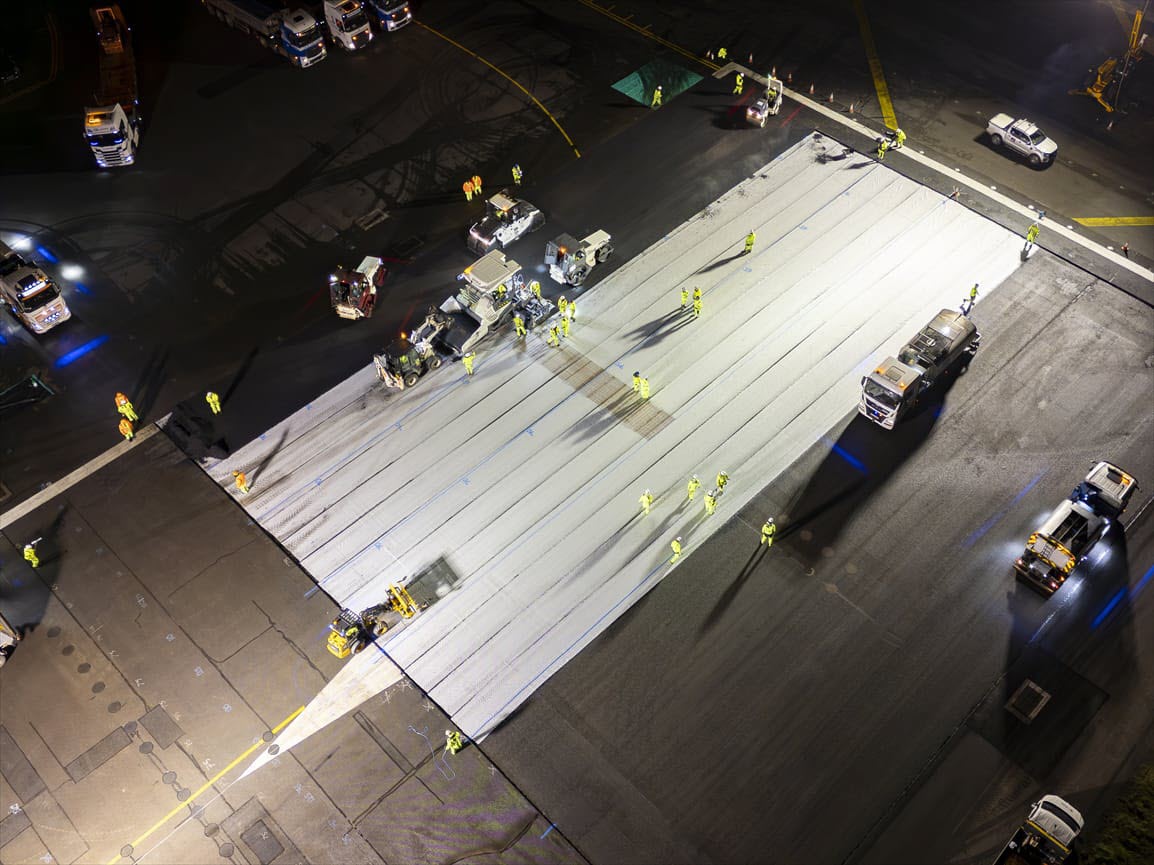
At Edinburgh Airport, a runway is more than just a surface.
It’s a critical asset that must perform under constant pressure – handling heavy aircraft
loads, tight operational schedules, and strict safety requirements. When it comes time
for an upgrade, durability isn’t optional, it’s essential.
So, when Asphalt Grid Systems was brought in as part of a recent £30 million
investment to future-proof the runway, the focus went beyond resurfacing.
“This isn’t just about putting a new layer on top,” says John Martin, Managing Director of
Asphalt Grid Systems.
“It’s about building something that will last under very demanding conditions.”
The project involves a full asphalt overlay incorporating a reinforced geosynthetic
interlayer – Polyfelt® PGM-G100/100 – alongside upgrades to lighting, drainage, and
monitoring systems.
Just as critical, albeit less visible, is the role of the materials that bind the system
together, including carefully selected bitumen grades.
Together, these elements form a system designed not just to perform, but to endure.
Designing a system, not just a surface
Asphalt Grid Systems’ approach is built around a simple principle: pavement
performance depends on how materials work together.
Rather than treating each layer in isolation, the company designs composite systems in
which reinforcement, asphalt, and binders are engineered to act as a single structure.
“We generally use this on schemes where they’ve got issues with concrete or they’re
overlaying concrete with asphalt,” Martin explains.
He believes these are some of the most challenging scenarios in infrastructure.
Concrete is strong but rigid, and cracks in the underlying layer can quickly propagate
through a new asphalt surface unless properly managed.
To address this, Asphalt Grid Systems uses a geosynthetic interlayer that reinforces the
pavement while acting as a stress-absorbing membrane. This mitigates the spread of
cracks and helps distribute loads more effectively – an approach that’s already proven
itself on roads and airports across the UK and Ireland.
That same approach is now being applied at Edinburgh Airport, where the stresses on
infrastructure are even more demanding.
The role of binders and where PMB fits
Within this system, the bond between layers is critical.
Before the interlayer is installed, the surface is prepared and sprayed with bitumen at a
controlled rate, creating the interface that allows the layers to perform as one. The
choice of binder – whether standard penetration grade or polymer modified bitumen
(PMB) – depends on how and where it will be used.
“We have to get that application right,” Martin says.
“Because that’s what allows the system to perform as one.”
In many cases, straight-run bitumen is used to meet practical requirements such as
application rates and handling. But in more demanding conditions – particularly at key
interfaces or higher in the pavement structure – PMB can offer additional benefits.
“Polymer modification increases elasticity and toughness across a wider range of
temperatures,” says Martin.
That enhanced performance under extreme conditions helps improve flexibility and
durability, reducing the risk of cracking and extending service life.
The key, however, is not the material in isolation, but how it contributes to the overall
system.
From early innovation to airport applications
This system-based thinking has also driven innovation in how materials are used.
On earlier projects, including a concrete road scheme in Sheffield, Asphalt Grid
Systems explored the use of PMB – specifically NYPOL® 77 – as part of a geosynthetic
system. It marked the first time this type of product had been used in this way in the UK.
“We really like NYPOL 77 as it offers a lot better properties in higher and lower range
temperatures than a normal PEN bitumen,” says Martin.
The results demonstrated how polymer modification could strengthen bonding and
improve performance at critical interfaces.
Since then, Asphalt Grid Systems has continued to refine its approach across a range
of applications, from roads to major airport projects such as Edinburgh, Glasgow
Prestwick, and Cork International Airport.
Each project builds on previous experience, applying the same core principle: design for
long-term performance from the outset.
Making durability measurable
For Asphalt Grid Systems, achieving durability is not just about materials, it is about
evidence.
To support design decisions, the company has developed its own computer modelling
tool, IRIS, which analyses several carefully chosen aspects of pavement design, such
as traffic data, layer materials, and thicknesses.
The platform provides precise values based on proven mathematical and engineering
processes displayed on easy-to-read graphs, allowing engineers to more easily
compare expected pavement life with and without reinforcement.
“It can be incredibly valuable information for understanding the long-term impact of
different design choices,” Martin explains.
In some scenarios, modelling shows that without reinforcement, cracking can appear
within just a few years. With the full system in place, that lifespan can extend several
times over.
This kind of transparency is increasingly important for engineers and asset owners,
helping them make informed decisions based on long-term value rather than upfront
cost.
It also reframes sustainability in practical terms: longer-lasting infrastructure means
fewer interventions, less material use, and reduced disruption over time.
Delivering under pressure
Executing a project like Edinburgh Airport requires more than technical expertise. It
depends on coordination across the supply chain, especially when working in a highly
controlled environment.
For Asphalt Grid Systems, collaboration with Nynas has played a key role.
“The service provided by Nynas for this project has been fantastic,” Martin says.
On airport sites, where access is restricted and timing is critical, ensuring reliable
delivery is essential.
“When they want the grid and they want the bitumen, it needs to be there. They don’t
want any delays,” he adds.
Consistent quality is equally important.
According to Martin, the bitumen supplied by Nynas – whether standard penetration
grade or PMB – has performed well both in handling and the finished result, contributing
to strong bonding between layers and smooth installation on site.
A shift toward long-term thinking
The work at Edinburgh Airport reflects a broader shift in how infrastructure is being
designed.
Rather than focusing solely on initial cost, there’s a growing emphasis on durability,
lifecycle performance, and making better use of resources.
Asphalt Grid Systems’ approach, which combines reinforcement systems, carefully
selected binders, and data-driven design, points toward a more resilient model for
infrastructure.
As Martin puts it: “If you can make these roads last longer, sustainability follows.”
From local roads to major runways, that principle is increasingly shaping both how
projects are delivered and how performance is measured.